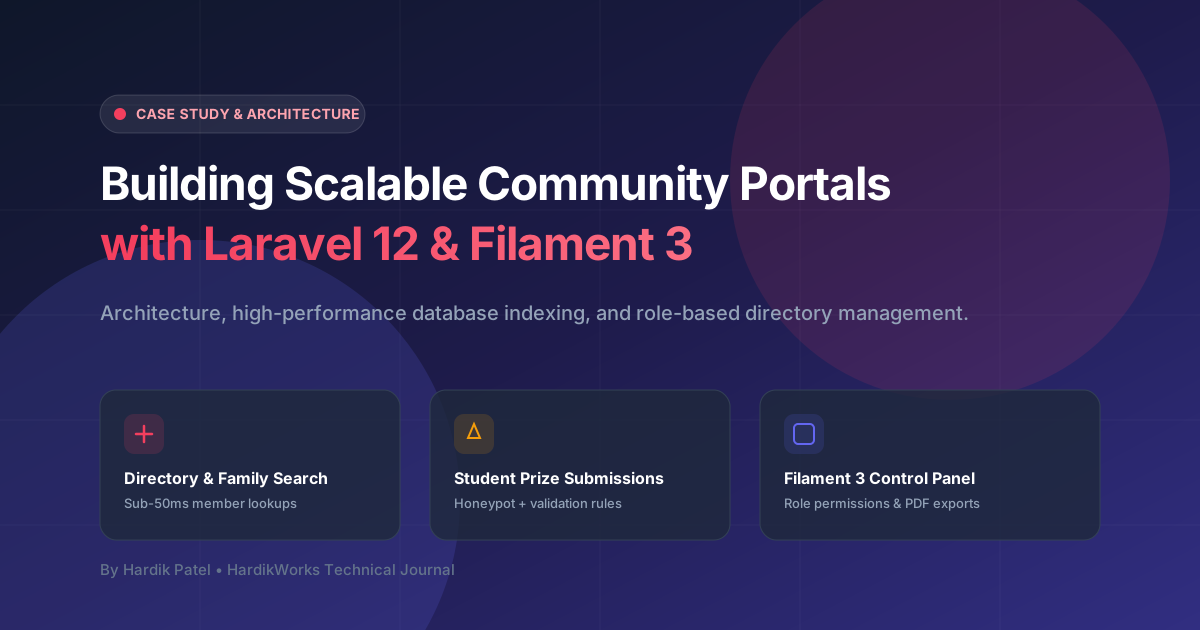
Building Scalable Community Portals with Laravel 12 & Filament 3
Architectural lessons, database performance tuning, and security best practices from designing high-traffic community directories and student portal systems handling thousands of verified members.
Modern community organizations, trusts, and non-profits often face a significant digital transition challenge. For decades, community directories, life membership registries, and annual student prize distributions were operated through physical paper registers, fragmented Excel spreadsheets, and informal communication channels.
When thousands of families across multiple cities depend on these directories to connect, verify memberships, and apply for educational scholarships, a traditional static website is simply not enough.
In this deep dive, we explore the architectural patterns, database performance optimizations, and administrative workflows used in building high-scale community portals such as Shree Mota Bhavan (22) K. P. Samaj Central Portal and Surat Trust Portal.
1. Multi-Tier Relational Data Modeling
A common pitfall when designing community portals is treating members as a flat list of users. In real-world community platforms, records are deeply relational:
- Families & Households: A single registered head of household with linked spouses, parents, and children.
- Geographic Roots: Native ancestral village (Gam), current residential city, and international diaspora addresses.
- Categorized Life Memberships: Categorized by trust branch, membership serial number, and verification status.
- Student Academic Submissions: Yearly educational prize applications with mark sheet verification, institute verification, and award status tracking.
// Schema architecture snippet for community membership indexing
Schema::create('community_members', function (Blueprint $table) {
    $table->id();
    $table->string('membership_number', 50)->unique();
    $table->string('head_name');
    $table->string('native_village', 100)->index();
    $table->string('city', 100)->index();
    $table->string('primary_phone', 20)->index();
    $table->json('family_members')->nullable();
    $table->string('status', 20)->default('verified')->index();
    $table->timestamps();

    // Composite index for sub-50ms directory searches
    $table->index(['native_village', 'city', 'status']);
});
By adding a composite index across ['native_village', 'city', 'status'], queries filtering members by ancestral root and residence execute in under 45 milliseconds, even when scanning directories with tens of thousands of records.
2. Streamlining Administration with Filament 3
Community trusts are typically governed by volunteer committee members and administrative clerks who require intuitive, reliable tools without steep learning curves.
By leveraging Filament 3 on Laravel 12, we provided a responsive, clean back-office experience:
- Live Counter Tabs: Fast tab switching between All Members, Verified, Pending Review, and Archived.
- 1-Click Approvals: Instant toggle actions allowing clerks to verify submitted prize forms directly from table rows without navigating into nested edit screens.
- Bulk PDF Generation: Generating formatted directory slips and certificates using headless Chromium or DomPDF in queued background jobs.
Tables\Actions\Action::make('verifyMember')
    ->label('Approve Membership')
    ->icon('heroicon-o-check-badge')
    ->color('success')
    ->requiresConfirmation()
    ->action(function (Member $record) {
        $record->update(['status' => 'verified', 'verified_at' => now()]);
        Notification::make()->title('Member verified successfully')->success()->send();
    });
3. Public Student Prize Distribution Forms with Anti-Spam Architecture
Annual student award programs receive thousands of public submissions during tight 2-to-3 week application windows. Ensuring reliable data collection while preventing bot spam and duplicate entries requires layered protection:
- Honeypot Verification: Hidden honeypot fields that trap automated bots without burdening genuine human applicants with annoying CAPTCHAs.
- File Upload Hardening: Securely storing student mark sheets and identity cards in private storage disks, strictly validating MIME types (
application/pdf,image/jpeg), and capping file sizes at 5MB. - Application Rate Limiting: Throttling form submissions by IP fingerprint to avoid server spikes.
4. Database Query Optimization & Caching Strategy
Public community portals experience extreme traffic spikes during annual general meetings, festival announcements, and student prize distributions. To maintain smooth sub-second page loads:
- Query Minimization: Eager loading relationships (
with(['category', 'links'])) on all public directory views to eliminate the $N+1$ query overhead. - Sitemap & Directory Caching: Caching directory counts and static announcements with automatic cache tags that invalidate immediately whenever an administrator publishes an update.
- Asset Optimization: Using responsive SVG graphics and modern WebP image formats for photo galleries.
Summary Checklist for Community Engineering
- Design familial and geographic schemas with composite indexes.
- Use Filament 3 for streamlined administrative oversight with custom action groups.
- Enforce honeypots and strict file-type validations on all public intake forms.
- Implement automated cache invalidation upon model updates.
- Ensure 100% mobile responsiveness for members browsing on handheld devices.